Draft 2
Visual
Pleasure and Cultural Contact
The Yokohama
Album
An
unexpected adventure into Japanese photography.
The Yokohama
Album is a term used to describe late 19th century Japanese albums of albumen
photographs hand tinted depicting studio and scenic views of Japan during the
Bakumatsu - Meiji period 1868 – 1912. The The late 19th century
Japanese term for photography, “ Shashin”
“ to copy the truth” or “realism”.
While
researching my great grand father James L. Breese, a society photographer in NYC
in the late 19th century, I acquired from my aunt a treasure from one of his
trips to Japan at the turn of the century. A beautifully decorated inlayed and
lacquered album of 19th century images of Japan and its people. I had little
information on the images so through the years it was always set aside. I had
many unanswered questions. Time to time when I presented the images to photo
historians they also had very little information to provide me other then they
were a common photographs for traveling tourists of the day.
Recently my
interest in the album has been renewed for I have been making images myself
using the one of the earliest methods of photography, wet plate collodion, “
Ambrotypes”. A process developed
in 1851 by Frederic Scott Archer. Collodion is poured on a glass plate and
carefully rocked back and fourth till is spread evenly on the glass plate,
which then is sensitized in a silver nitrate solution and has to be exposed and
developed while it is still wet. This rare and historic process produces a
stunning high quality negative and positive. It was employed by well-known
photographers as William Henry Jackson and Civil war photographer Mathew Brady.
It was at this point when I came to learn that the wet plate process I was
exploring had been used in many of the images from the Yokhama Album. Thus my
interest in this album was renewed.
Now twenty
years since acquiring the album the resources for research on the Internet have
dramatically grown and with it exciting new information has surfaced answering
many questions about this rare album. It has been an enlightening crash course
on 19th century Japan and its beginnings in photography. Through the Nakasaki
University on line archives, (http://oldphoto.lb.nagasaki-u.ac.jp) Terry Bennet
and Rob Oechsle, I was able to identify a large portion of the collection. I
found the locations the studios and many of the photographers behind the
camera. This journey of rediscovery has led me into learning the personalities
and styles of many of the photographers to the point where I now can identify
with confidence many of the remaining “ unknown photographers”. But at this
point they still have to be left as unknown till I can verify it with an image
match from a university, museum collection or specialist in the field. Also it
should be noted only half of the album can be displayed for each page of the
album has a mounted photograph both on the front and the back thus I had to
choose one side or the other. This was a difficult editing process. You can see
the total set and full descriptions at www.gallerysink.com “ Breese Japan.
In the last
couple years several books have been published on the subject.
Terry
Bennett who was very friendly and helpful in my research:
I highly
recommend his book if your interested in the subject.
Photography
in Japan 1853-1912
By Terry
Bennett
Published by
Tuttle Publishing, 2006
ISBN
0804836337, 9780804836333
320 pages
Old Japanese
Photographs Collectors' Data Guide
By Terry
Bennett
Published by
Old Japan (November 15, 2006)
ISBN-10:
0955400007, 13: 978-0955400001
300 pages
And others:
The History
of Japanese Photography:
By Anne
Wilkes Tucker,, Ktar Iizawa, Kaneko Ryuichi, Dana Friis-Hansen, Naoyuki
Kinoshita, Takeba Joe, Museum of Fine Arts, Houston.
Published by
Yale University Press
ISBN
0300099258, 9780300099256
405 pages
Reflecting
Truth: Japanese Photography in the Nineteenth Century
By Nicole
Coolidge Rousmaniere, Mikiko Hirayama, Sainsbury Institute for the Study of
Japanese Arts and Cultures
Contributor
Nicole Coolidge Rousmaniere, Mikiko Hirayama
Published by
Hotei, 2004
ISBN
9074822762, 9789074822763
111 pages
Also my kind
thanks for support from Rob Oechsle who’s dedicated research has answered many
a questions for myself historians world wide.
His essay “
Searching for T. Enami ” is an
amazing find.
And thank
you Adam Lerner the director of the fine museum “ The Lab” in Denver Colorado
for setting me a sail into this exciting
project of rediscovery.
Mark Breese Sink
From the collection of Mark Sink
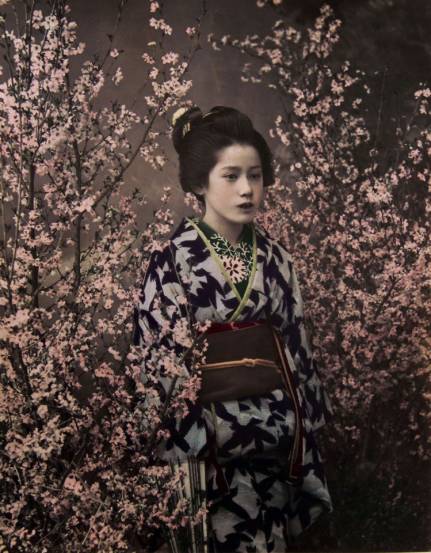
*Ogawa Kazuma
"The Beauty with Sakura "
Bakumatsu - Meiji period 1868 - 1912
Hand Colored Albumen print
8x10" image 12x15" mount
A young woman with a parasol in her right hand wearing a kimono stands with
three quarters of her body facing the front. Small cherry trees stand in full
bloom to her right and left, This picture is called "the beauty with
sakura ". It is a masterpiece of Ogawa Kazuma.
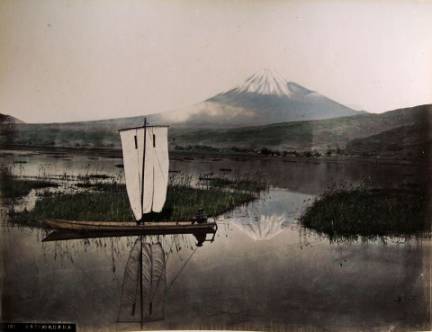
*Kusakabe Kimbei
Tamamura Kihei
“Shizuoka”
Bakumatsu - Meiji period 1868 – 1912
Hand Colored Albumen print
8x10" image 12x15" mount
Kashiwabara is located on the left bank of the mouth of Katsumata River,
which pours into Suruga Bay. This may be the low wetlands near the mouth of the
river. A sailing boat can be seen to the left and Mt. Fuji in the centre. The
cameraman may have taken the photo from a boat. In the Morse Collection at the
Salem Peabody Museum, there is a photo which is believed to be developed from
the same negative as this photo. ( "Japan as seen by Morse ",
published by Shogakkan).
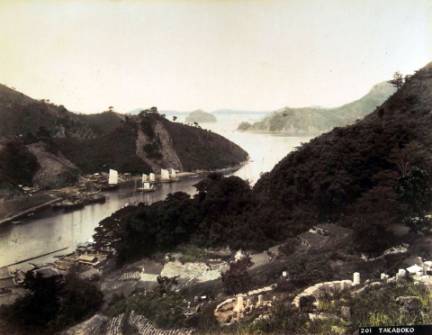
*201 Takaboko
A picture of the view of Takahoko Island at the mouth of the Nagasaki
Photographer T. Enami
Nagasaki Bay Area
Bakumatsu - Meiji period 1883-1897
Hand Colored Albumen print
8x10" image 12x15" mount
This is a photo from the large lacquer-coated album of Kusakabe Kinpei and
Ogawa Kazuma, with the caption,"201Takaboko." This is Ogawa's
classification number. The photo was taken between 1892 and 1897. It is a view
of Takahoko Island at the mouth of Nagasaki Harbour from the hillside of
Tomachi. The cape beyond is Kozaki and the tip is Kozakibana, with Kaminoshima
overlapping in the background. The area in the foreground is Megami, the
narrowest channel on the approach to Nagasaki. In the Edo period, there were
guard stations on the two banks, Tomachi and Nishidomari, and the Bizen Clan
and Fukuoka Clan took turns every year to keep watch over the entrance to the
harbour. There are many photos taken from this angle, but this photo provides a
particularly clear view of the houses, cemetery, and sailing vessels in the
harbour. Coal is stacked up in a stockyard on the opposite bank. The ship, an
"isaba-sen" or fishing boat, seems to specialize in transporting coal
from Takashima Island lying behind Takahoko Island in outer Nagasaki Harbour.
The coal stocked here was probably supplied to ships visiting Nagasaki. The
misty island in the centre is Takahoko Island. The cape sticking out from the
right is Kanzaki, and from the left is Megami. In Tomachi, there was a
guardhouse watching over boats coming into Nagasaki Harbor.
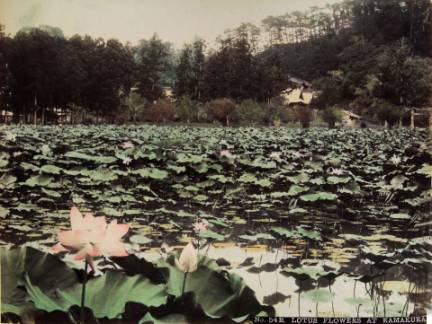
*Tamamura Kozaburo
Collection; Ogawa; Kazumasa
Bakumatsu - Meiji period 1868 - 1912
Hand Colored Albumen print
8x10" image 12x15" mount
A lotus pond at Tsurugaoka Hachimangu Shrine.5
The photograph is labeled "No.53B. LOTUS FLOWERS AT KAMAKURA." A
wooden torii gate is visible on the right. The red building on the left is
Wakamiya, indicating that the building above it is the Jogu cloister. The
riding trail said to have surrounded the pond during the Meiji Period. The vast
size of the pond is emphasized by the comparison of the great lotus flower in
the front and the trees in the distance.This photograph is included in the
"Tamamura Kozaburo Collection." The date of the photograph is not
known.
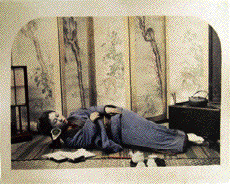
*Tamamura Kozaburo
Bakumatsu - Meiji period 1868 - 1912
Hand Colored Albumen print
8x10" image 12x15" mount
A woman has fallen asleep while reading and her head is resting on a high
pillow. There is a traditional Japanese brazier by her feet, and water is being
boiled in an iron kettle. There is a tea set (a teapot and teacups) on the
round tray in front of her. A lamp stands next to her head. Monkeys are painted
on the folding screen behind her.
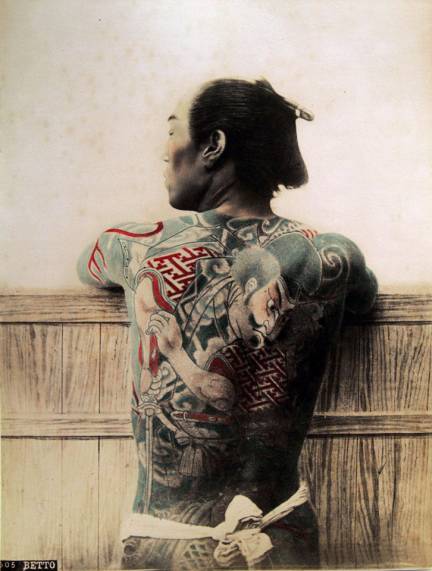
*“Betto”
Kusakabe Kimbei
Tamamura Kozaburo
Bakumatsu - Meiji period 1868 – 1912
Hand Colored Albumen print
8x10" image 12x15" mount
A tattooed man leans against a wall. The colors were applied following the
outline on the subject's back. This popular design was photographed by a number
of different photographers.
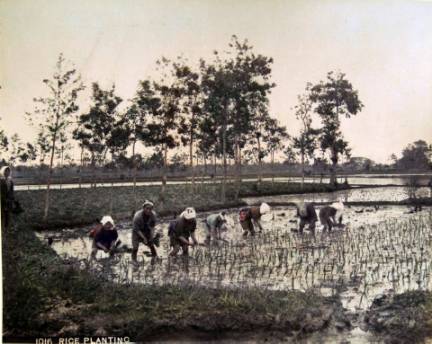
Photographer Unknown
Bakumatsu - Meiji period 1868 - 1912
Hand Colored Albumen print
8x10" image 12x15" mount
Five women with hair covers and two men wearing headbands are planting rice
shoots in a rice paddy. They line up, plant the rice shoots in a row, then step
back and plant another row at an equal interval.
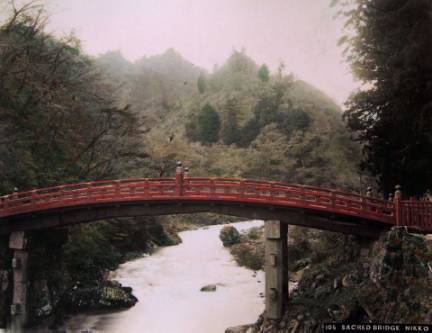
105 Sacred Bridge Nikko
Kamibashi Bridge,the Otani River
NIKKO DAIYAGAWA
Kusakabe Kimbei
Bakumatsu - Meiji period 1868 - 1912
Hand Colored Albumen print
8x10" image 12x15" mount
Before 35th year of Meiji
Nikko .The Kamibashi Bridge over Daiyagawa was painted red and located at
the entrance of Nikko Shaji. Lost in a flood in 1902, the bridge had joints in
the bridge girder as shown in the left side of the photo. The present Kamibashi
has no joints in the bridge girder. There are no utility poles seen in the
photo on the right hand Rinoji Temple side.
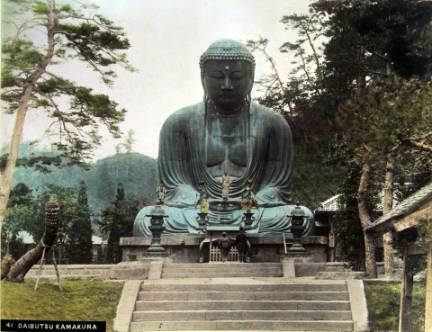
*Daibutsu (the Great Buddha) of
Kamakura
Ogawa Kazumasa
Bakumatsu - Meiji period 1868 - 1912
Hand Colored Albumen print
8x10" image 12x15" mount
The Great Buddha has a height of
11.36 meters. The size can be understood from the comparison with the person in
the photo. It is said to be a statue of a sitting Amida Bodhisattva.
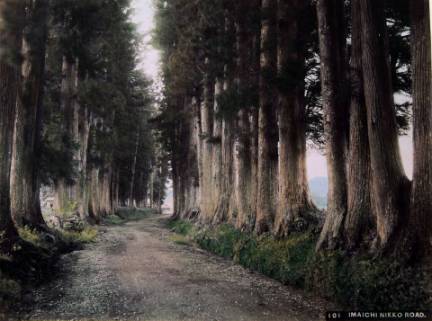
Ogawa,Kazumasa
Cedar boulevard in Nikko Kaido
Bakumatsu - Meiji period 1868 - 1912
Hand Colored Albumen print
8x10" image 12x15" mount
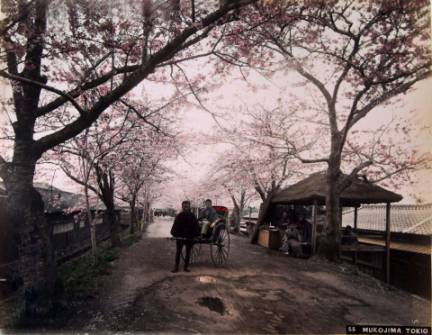
*Uneo Park 55 Mukojima Tokio (Tokyo)
T. Enami
Bakumatsu - Meiji period 1868 - 1912
Hand Colored Albumen print
8x10" image 12x15" mount
In 1717, the 8th Shogun Tokugawa
Yoshimune planted 100 cherry trees along the Mukojima riverbank, and the spot
became popular for cherry blossom viewing. In 1883, when Okura Kihachiro
planted an additional 1,000 trees here, the riverbank became full of cherry
blossoms. Many simple teahouses were built along the riverbank for the use of
visitors
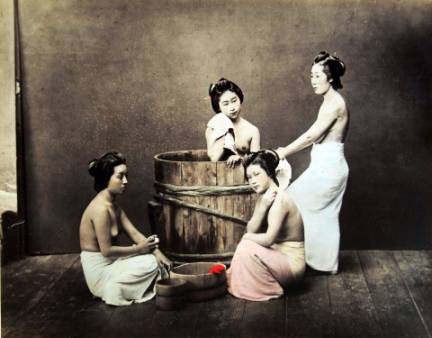
“Home Bathing”
Unknown Photographer
Ogawa Kazumasa ?
Bakumatsu - Meiji period 1868 - 1912
Hand Colored Albumen print
8x10" image 12x15" mount
"Home Bathing." This scene
of women bathing .A wooden bathtub is placed in a home bathroom setting . A young
woman sits in a wooden pail bathtub, while the woman on the left stoops to wash
her body with a hand towel. A half-naked woman stands on the right, This is a
studio photograph depicting the life of the common people.
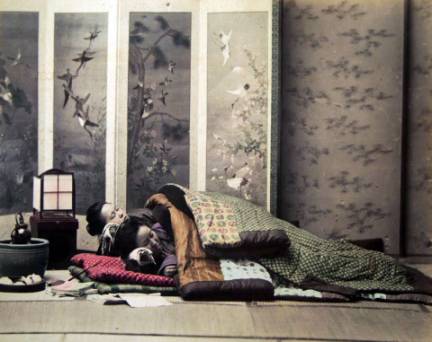
*Tamamura (album 1)
Bakumatsu - Meiji period 1868 - 1912
Hand Colored Albumen print
8x10" image 12x15" mount
Two women are sleeping side by side
in the winter. The mattress is double layered, and two blankets are being used.
There is an "andon" lamp and a brazier with a kettle near them. A
folding screen illustrated with cranes is visible in the rear.
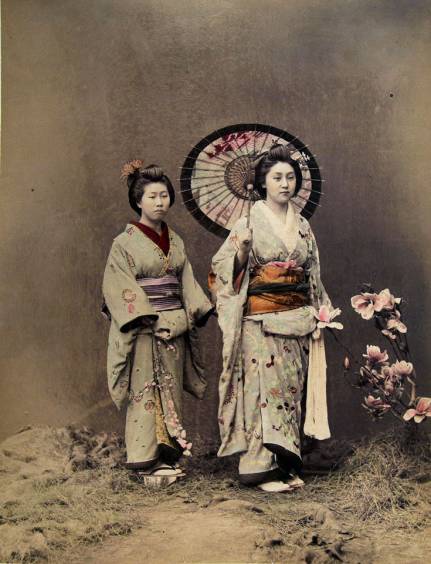
*Unknown Photographer
Bakumatsu - Meiji period 1868 - 1912
Hand Colored Albumen print
8x10" image 12x15" mount
Girls with beautiful kimono are
standing with a "bangasa" umbrella. Bangasa umbrellas became popular
among the common people during the Edo Period and were used widely. Prior to
the late-18th century, straw raincoats and sedge hats were used for protection
from the rain.
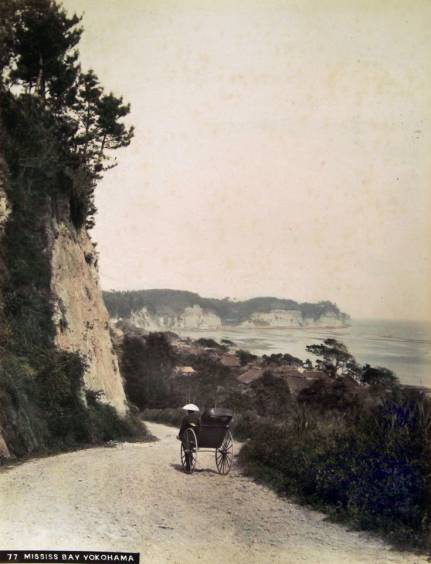
*Honmoku Point seen from Fudozaka
Slope
Yokohama
Photographer T. Enami
Bakumatsu - Meiji period 1868 – 1912
Hand Colored Albumen print
8x10" image 12x15" mount
The promenade through from the Bluff of Yokohama to
the hills in Negishi lead to the Fudosaka down to the beach. This photo was the
place near Negishi village down from the Fudosaka. The village below is the
Negishi village and the above is the Honmoku cape.
Negishi Bay was known to foreigners
as "Mississippi Bay" after the nickname given to it by Commodore
Perry. Part of the new road built for foreigners, Fudo Slope was praised by
them as "one of the most beautiful scenes in the world." This area
was later reclaimed from the ocean and is presently an industrial zone.
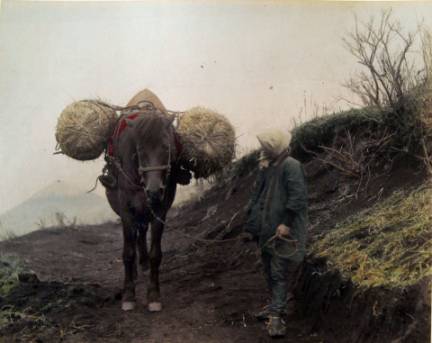
*Mt. Fuji seen from the Otome Pass
Unknown Photographer
Bakumatsu - Meiji period 1868 - 1912
Hand Colored Albumen print
8x10" image 12x15" mount
Shizuoka
Mt. Fuji viewed from Otome Pass at
the border of Shizuoka and Kanagawa Prefectures, facing west. Otome Pass is
part of the road to Gotenba, Shizuoka Prefecture via Sengokubara (Kanagawa) and
Hakone. It has been famous since ancient times for its spectacular view of Mt.
Fuji. During the Edo Period, travel restrictions were enforced and people were
not allowed to pass. This photograph was taken close to the top of the pass.
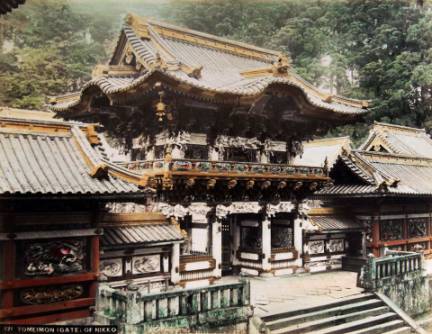
Nikko Toshogu
Yomeimon gate of Nikko
Photographer T. Enami
Bakumatsu - Meiji period 1868 - 1912
Hand Colored Albumen print
8x10" image 12x15" mount
The facade of the Yomei Gate. A panel with the
autograph of the Emperor Gosuio is hung in the center, and the upper layer is
covered with carvings of dragons and the lower layer is covered with carvings
of Chinese lions. The wall to the left and right is placed a statue of Zuishin.
The wing moat to the right and left and the corridor connected to it has carvings
in brilliant colors.
This is the rear of Yomeimon. The
symbol of Nikko Toshogu, this gate displays craftsmanship and decorative
techniques representative of the early Edo Period. The carvings on the gate
total 508 in number and include people, animals (real and imaginary), flowers,
birds, and patterns. It is also called "Higurashimon" (Evening
Falling Gate) because visitors can stand looking at it all day long and still
not tire of its beauty.
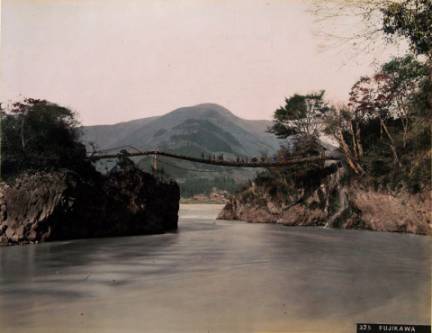
The Kamaguchi-bashi,a suspension
bridge over the Fuji River
Shizuoka
Photographer T. Enami
Bakumatsu - Meiji period 1868 - 1912
Hand Colored Albumen print
8x10" image 12x15" mount
View, facing south, of the suspension
bridge over Kamaguchi Gorge (a rugged section of Fuji River) between Naganuki
in Shibakawa-cho and Setojima. The rapid flow of Fuji River makes bridges
difficult to maintain. During the Edo Period, this was the only bridge over the
river. Both banks are cliffs, and the width of the river is at its narrowest
here. Several people are on the bridge, which is made of bamboo, wisteria vines
and planks. There is also a suspension bridge made only of vines.
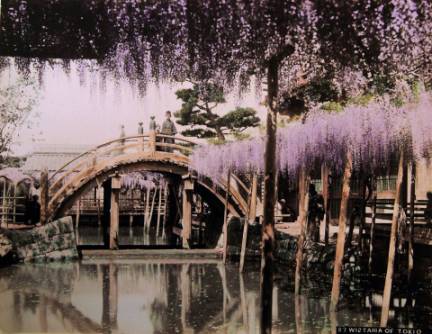
A wisteria trellis at Kameido Shrine
Photographer T. Enami
Tamamura,Kihei (Album)
Bakumatsu - Meiji period 1868 - 1912
Hand Colored Albumen print
8x10" image 12x15" mount
The English caption reads "Wisteria vine ".
The wisteria vine of Kameido Tenjin in Tokyo was a famous site, and many photos
of it remain.
Many festivals are celebrated throughout the year at
Kameido Tenjin Shrine. While the Wisteria Festival is well-known, "Usokae
Shinji" is also popular. This event is based on the belief that the
mythical "uso" bird returns from the previous year and brings good
luck with it. The conversation staged between the shrine priest and an oni (devil)
at the "Setsubun Tsuinasai Festival" in February is also interesting.
Since the oni has four eyes, the roof of the shrine office is embellished with
ceramic tiles showing a devil with four eyes.
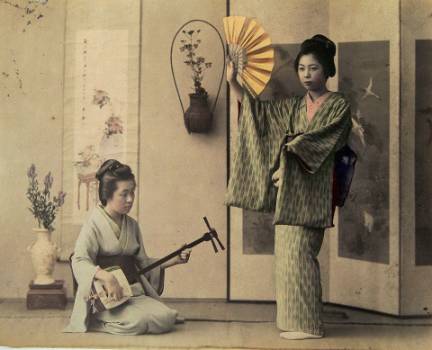
Dance lesson
Unknown Photographer
Bakumatsu - Meiji period 1868 - 1912
Hand Colored Albumen print
8x10" image 12x15" mount
Two young women wearing long-sleeved kimono practice
Japanese dancing. One opens her fan, and the other sits on a cushion to play
the shamisen. The background suggests a room, but the mat under their feet is
inappropriate.
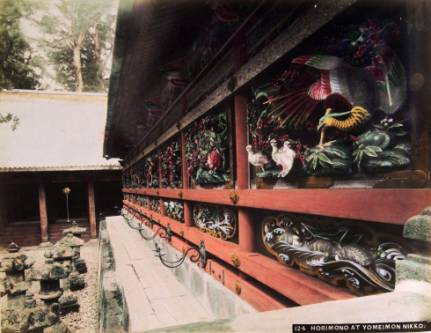
124_horimono_at_yomeimon_nikko
Photographer T. Enami
Bakumatsu - Meiji period 1868 - 1912
Hand Colored Albumen print
8x10" image 12x15" mount
Carvings at the cliosters of the Yomeimon Gate,Toshogu
Shrine,Nikko
This is the south side of the 220m corridor that
stretches east to west from the "sodebei" wall of Yomeimon at Nikko
Toshogu. The south side is decorated with 25 different carvings. A candlestick
is attached to each carving to light the corridor.
The corridor to the right and left of Yomei Gate has
pillars painted in red and divided in 15 sections to the right and 8 sections
to the left. It is divided by perpendicular wooden pillars, with flowers,
birds, and waterfowl carved in the panel boards. It is covered in gold and
painted in brilliant green, red and other colours. The buildings of Toshogu
feature about 5,000 different carvings of 100 types of animal and plant.
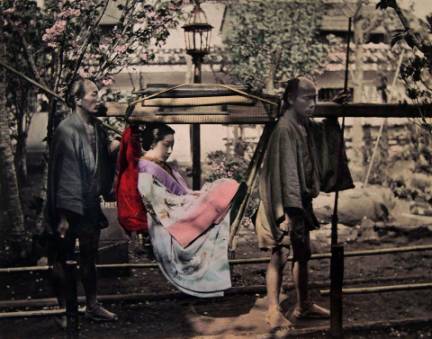
*Shitekago
Unknown Photographer
Bakumatsu - Meiji period 1868 - 1912
Hand Colored Albumen print
8x10" image 12x15" mount
A woman is riding on a palanquin used for road and
mountain passages. The bottom part of the seat is made of braided bamboo and
shows no sagging. A cushion absorbed shocks. This may be a
"shitekago" because the straw curtain seems to be rolled up. This
kind of palanquin was made simply of four bamboo poles and braided bamboo
sticks with straw curtain attached. The palanquin bearers had no set uniforms
but carried "ikizue" (breath sticks) to regulate breathing.
Bearers of carriages were called "rokushaku"
and were distinguished from palanquin bearers. At lodging towns on main routes,
kumosuke, or palanquin bearers, demanded money other than tips. The usual
palanquin ran one Japanese mile in an hour, but the quick palanquins ran the
distance between Edo and Kyoto in four days and a half.
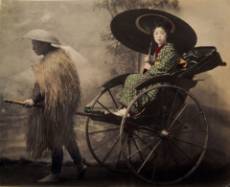
*A women riding a "jinrikisha" (rickshaw)
Unknown Photographer
Bakumatsu - Meiji period 1868 - 1912
Hand Colored Albumen print
8x10" image 12x15" mount
Rickshaws became popular instead of the palanquins
after the Meiji era. A woman holds an umbrella and the rickshaw man bends
forward. A photo with a popular structure.
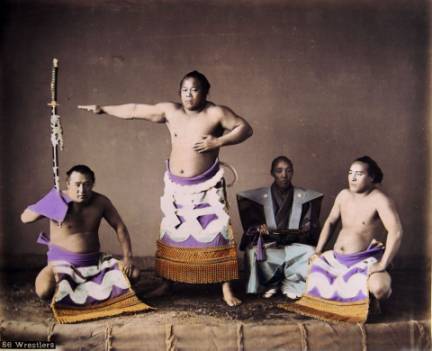
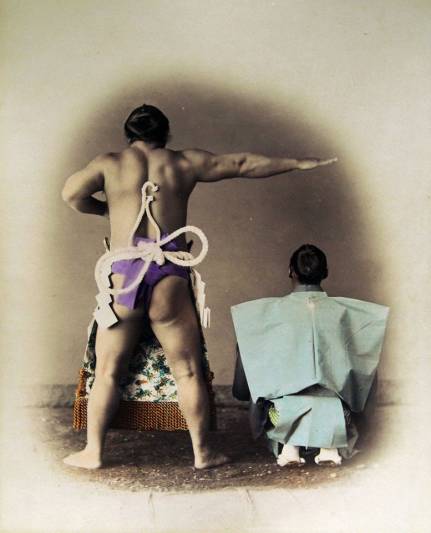
A sumo champion performing pre-match rituals.
Unknown Photographer
Bakumatsu - Meiji period 1868 - 1912
Hand Colored Albumen print
8x10" image 12x15" mount
A "yokozuna" (grand champion sumo wrestler)
enters the ring in ceremonial style. He is flanked on the left and right by the
"tachimochi" sword bearer and "tsuyuharai" herald.
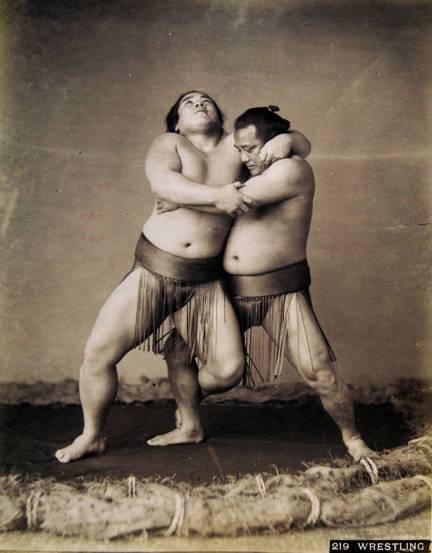
*219 Wrestling
Photographer Adolfo Farsari (Studio)
Possibly acquired from early Beto/ Stillfried studio.
Late Meiji (1898-1912)
Hand Colored Albumen print
8x10" image 12x15" mount
This is a staged photograph depicting sumo included in
a Yokohama album*. The ring was made for the occasion at the studio. The men's
physique suggests that they are professional sumo wrestlers. The technique
demonstrated is called "kirikaeshi" (twisting backward knee trip).
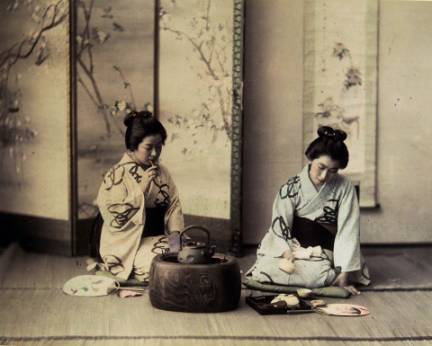
Two Woman , Smoking and Tea
Photographer Unknown
Bakumatsu - Meiji period 1868 - 1912
Hand Colored Albumen print
8x10" image 12x15" mount
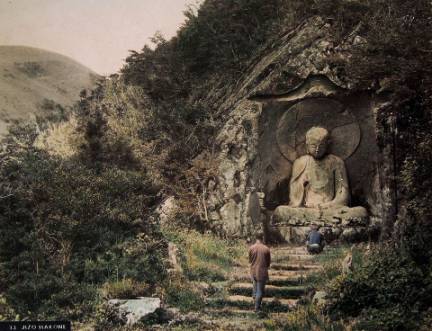
33 Jizo Hakone
Photographer T. Enami
Bakumatsu - Meiji period 1868 - 1912
Hand Colored Albumen print
8x10" image 12x15" mount
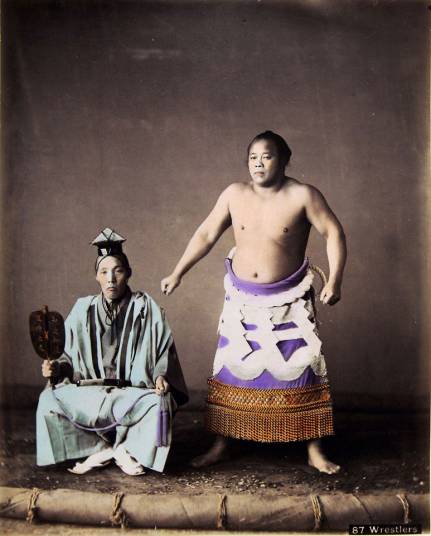
87 Wrestlers
Photographer Unknown
Bakumatsu - Meiji period 1868 - 1912
Hand Colored Albumen print
8x10" image 12x15" mount
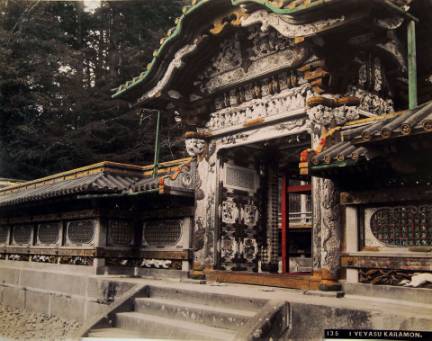
*135 Iyeyasu Karamon
Photographer T. Enami
Bakumatsu - Meiji period 1868 - 1912
Hand Colored Albumen print
8x10" image 12x15" mount
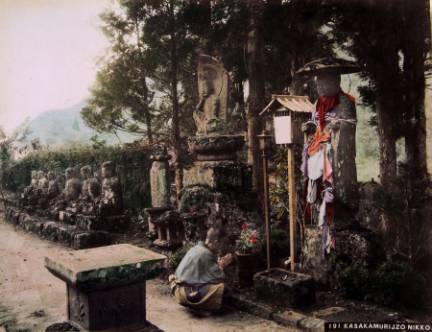
191 Kasakamurijzo Nikko
Photographer T. Enami
Bakumatsu - Meiji period 1868 - 1912
Hand Colored Albumen print
8x10" image 12x15" mount
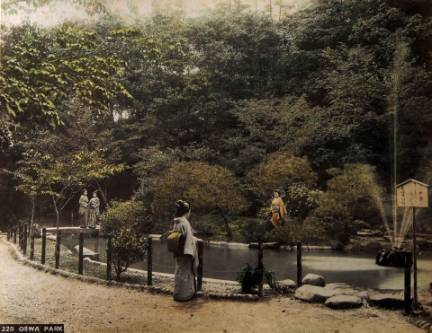
*220 Oswa Park
Photographer T. Enami
Bakumatsu - Meiji period 1868 - 1912
Hand Colored Albumen print
8x10" image 12x15" mount
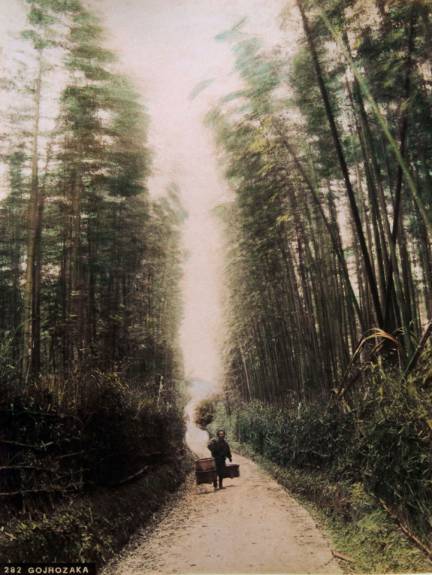
282 Gojrozaka
Photographer T. Enami
Bakumatsu - Meiji period 1868 - 1912
Hand Colored Albumen print
8x10" image 12x15" mount
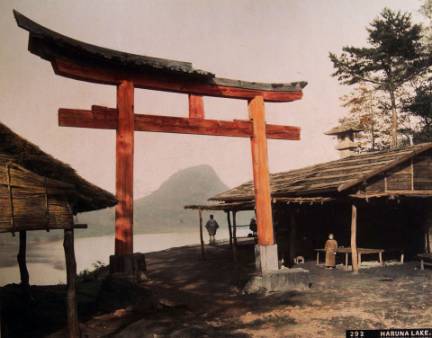
*292_Haruna_lake
Photographer Unknown
Bakumatsu - Meiji period 1868 - 1912
Hand Colored Albumen print
8x10" image 12x15" mount
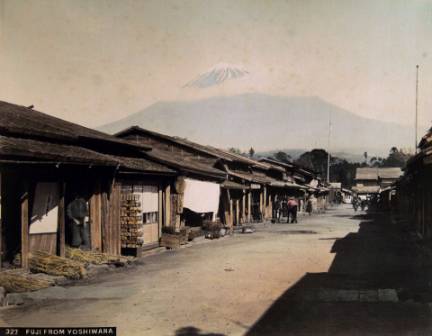
327_fuji_from_voshiwara
Photographer Unknown
Bakumatsu - Meiji period 1868 - 1912
Hand Colored Albumen print
8x10" image 12x15" mount
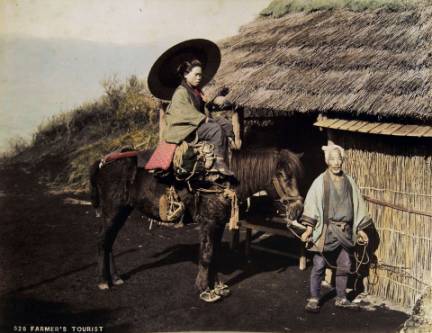
*528 Farmers Tourist
Photographer T. Enami
Baumatsu - Meiji period 1868 - 1912
Hand Colored Albumen print
8x10" image 12x15" mount
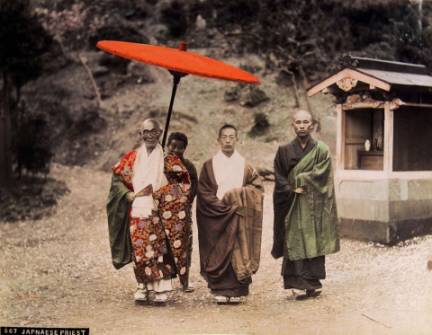
*567 Japnaese Priest
Photographer T. Enami
Bakumatsu - Meiji period 1868 - 1912
Hand Colored Albumen print
8x10" image 12x15" mount
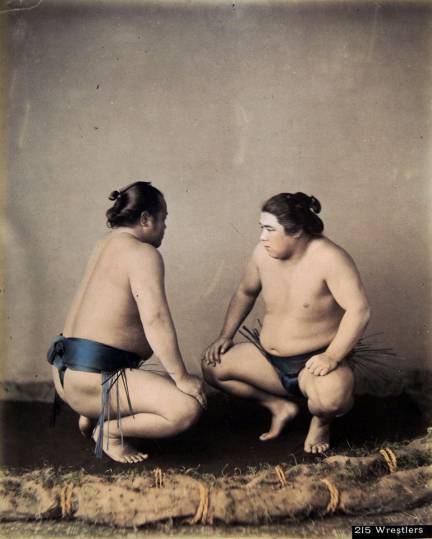
*215_Wrestlers
Photographer Unknown
Bakumatsu - Meiji period 1868 - 1912
Hand Colored Albumen print
8x10" image 12x15" mount

C 26 Fuji-Yama from Yoshiwara
Photographer Adolfo Farsari (Studio)
Possibly acquired from early Beto/ Stillfried studio.
Bakumatsu - Meiji period 1868 - 1912
Hand Colored Albumen print
8x10" image 12x15" mount
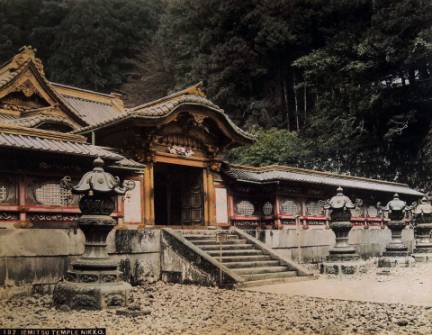
187 Iemitsu Temple Nikko
Photographer T. Enami
Bakumatsu - Meiji period 1868 - 1912
Hand Colored Albumen print
8x10" image 12x15" mount
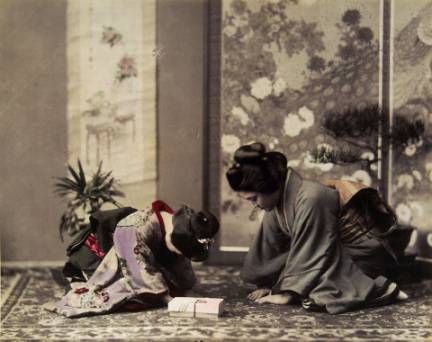
*daughter_woman
Photographer Unknown
Bakumatsu - Meiji period 1868 - 1912
Hand Colored Albumen print
8x10" image 12x15" mount
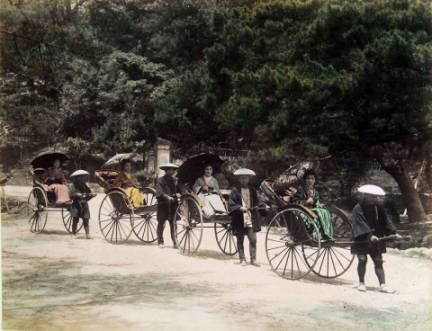
*four_carts_with_woman
Photographer Unknown
Bakumatsu - Meiji period 1868 - 1912
Hand Colored Albumen print
8x10" image 12x15" mount
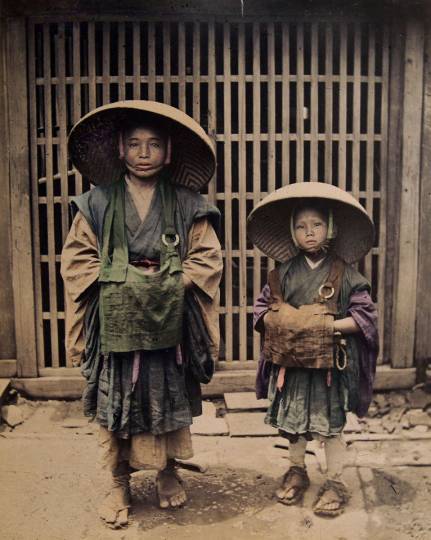
*Kids
Photographer Unknown
Bakumatsu - Meiji period 1868 - 1912
Hand Colored Albumen print
8x10" image 12x15" mount
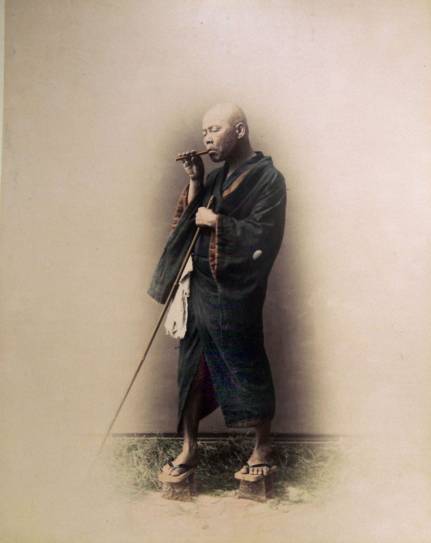
*Coolie_smoking
Photographer Unknown
Bakumatsu - Meiji period 1868 - 1912
Hand Colored Albumen print
8x10" image 12x15" mount
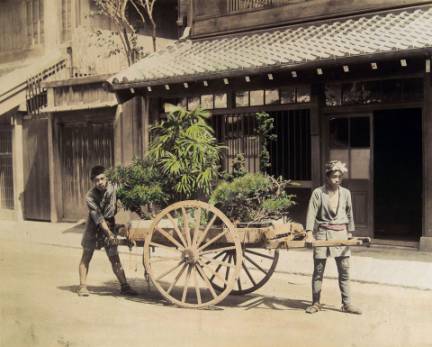
Plants on cart two boys
Photographer Unknown
Bakumatsu - Meiji period 1868 - 1912
Hand Colored Albumen print
8x10" image 12x15" mount
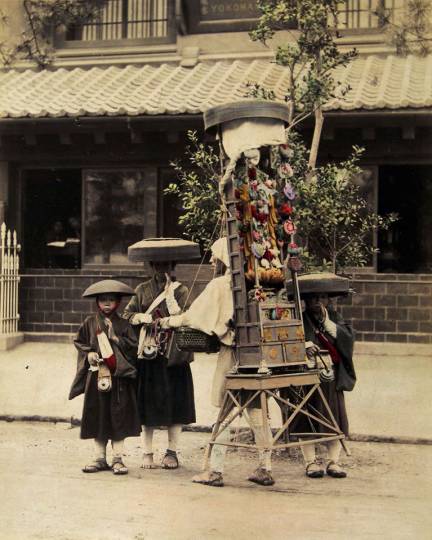
Street puppet man with children
Photographer Unknown
Bakumatsu - Meiji period 1868 - 1912
Hand Colored Albumen print
8x10" image 12x15" mount
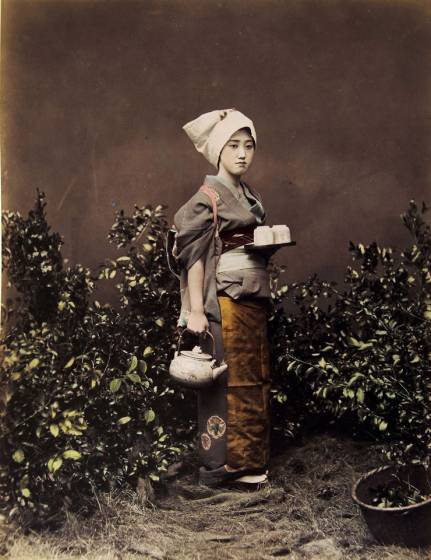
*Tea Server
Photographer Unknown
Bakumatsu - Meiji period 1868 - 1912
Hand Colored Albumen print
8x10" image 12x15" mount
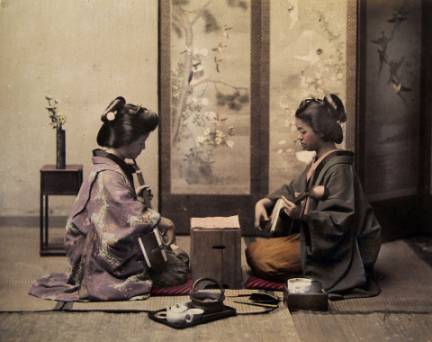
Two woman playing music
Bakumatsu - Meiji period 1868 - 1912
Hand Colored Albumen print
8x10" image 12x15" mount
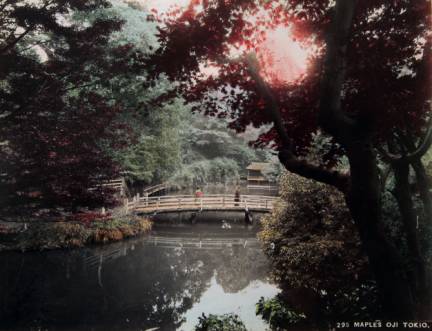
295 Maples Oji
Photographer T. Enami
Bakumatsu - Meiji period 1868 - 1912
Hand Colored Albumen print
8x10" image 12x15" mount
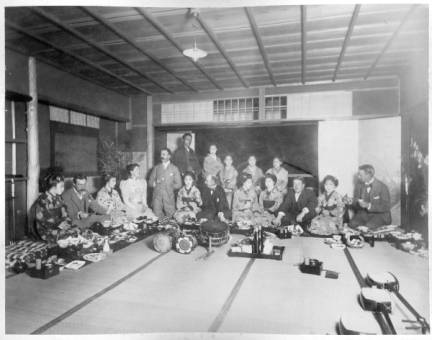
Breese
group opening page of Yokohama Album
Photographer Unknown
Bakumatsu - Meiji period 1868 - 1912
Hand Colored Albumen print
8x10" image 12x15" mount